Solstice Alleycat · 2026
A map with no answer
Ten checkpoints, ten hours and no prescribed route. The Solstice Alleycat begins with a map, but the decisions belong to the rider.
Most cycling trials begin by telling you where to go. The Solstice Alleycat takes that certainty away, leaving a map, ten checkpoints and a winter day that will not wait.
Some riders will spend hours studying the map, drawing imaginary lines between places and convincing themselves they have found the answer. Others will arrive with little more than an instinct for which direction to turn first. Once the field leaves Warwick, those plans meet the road.
A section takes longer than expected. Another rider appears somewhere you did not expect them to be. The remaining light begins to feel more valuable. The question is not simply how far or how fast you can ride, but how wisely you use what you have been given.
Before the start
The 2026 checkpoint map was designed to resist an obvious route. Lark Stoke draws riders towards the highest road in Warwickshire. Evesham Bell Tower pulls the map west. Wootton Wawen and Ladbroke Church create combinations that look straightforward until you begin asking what they cost later in the day.
Some checkpoints sit naturally together. Others tempt you away from the easiest line home. An efficient passage through all ten is expected to cover around 160 kilometres, but two riders can cover almost the same distance and have entirely different days. The order changes what becomes possible next.
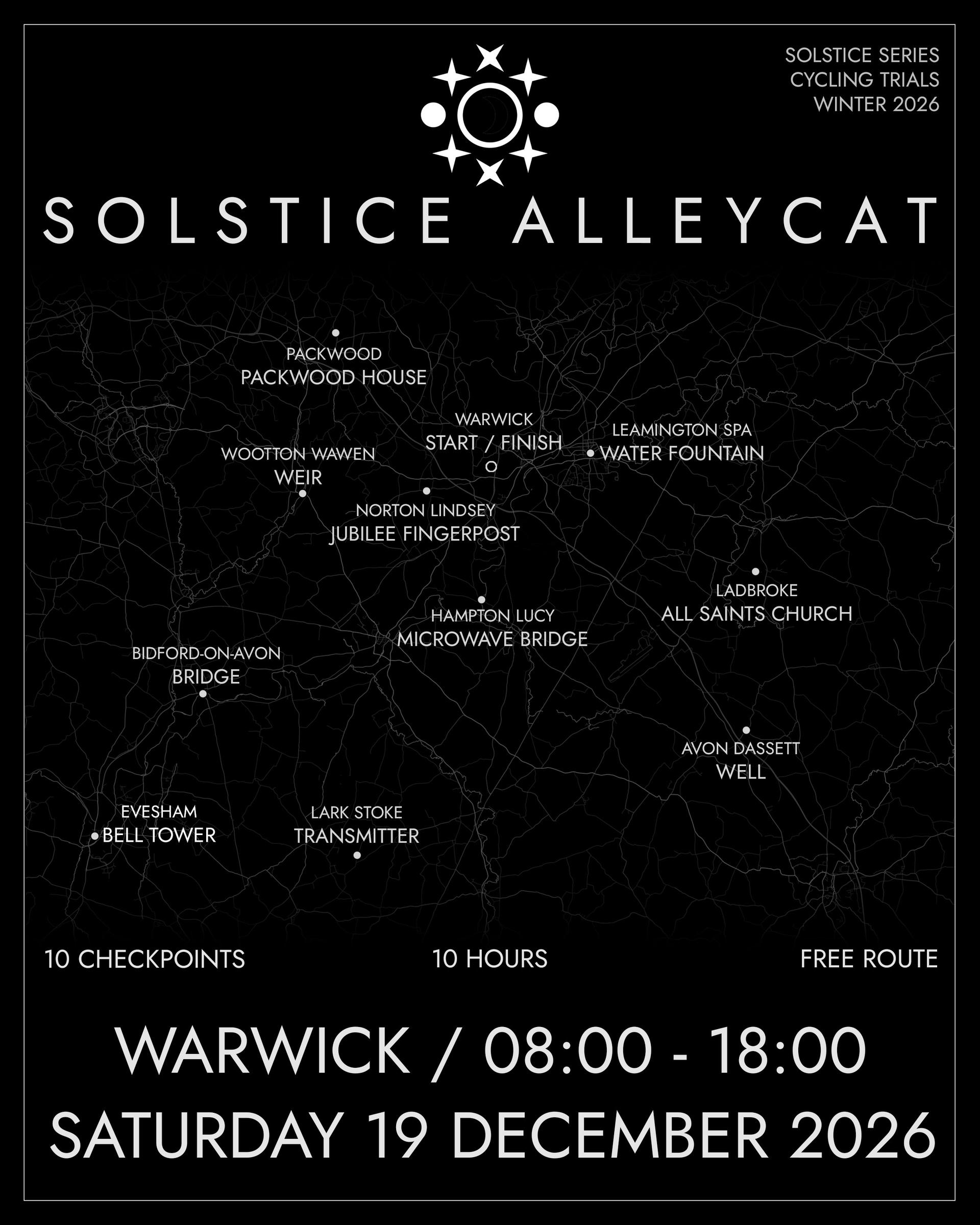
That is why the map is released in advance. For many riders, the trial begins before the start line, somewhere between a kitchen table, a map and the suspicion that there might be a better way through it.
The second calculation
Under the 2026 rules, each checkpoint is worth one point. The first five riders in each category receive six, five, four, three and two points respectively, replacing that standard point. All subsequent riders receive one point. Scoring is calculated separately for Female Solo, Male Solo and Pairs. Final classification is by total points, with ties sharing the position.
Arriving early can change a checkpoint’s value, but chasing it may commit a rider to a less efficient line through the rest of the map. Speed matters. It does not solve the trial.
The tension is deliberate: when to attack a distant checkpoint, when to accept that somebody else will reach it first, and when to abandon a plan that looked perfect the night before. Beneath the scoring sits the simpler requirement for the 2026 Trial Pass: all ten checkpoints and a return to headquarters before 18:00, within the ten-hour window.
The road back
Winter makes every decision more expensive. Light disappears, temperatures fall and every unnecessary kilometre consumes something that cannot be replaced. Eventually, looking outward gives way to thinking about the road back to Warwick.
Riders share the same landscape, the same information and the same finite amount of time. They do not return with the same story. A theoretically perfect route, twenty minutes lost, a plan abandoned just in time: hundreds of small decisions become different journeys.
For riders following the wider Series, the Alleycat is the winter passage towards Perseids Prime. It also stands on its own. Ten hours in a winter landscape, without somebody else deciding the route.